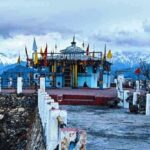

The Triyuginarayan Temple is a Hindu temple situated in the Triyuginarayan village of the Rudraprayag district, Uttarakhand. The ancient temple is dedicated to Lord Vishnu. The Triyuginarayan temple is also known as the Trijugi Narayan temple or the Akhand Dhuni temple among locals.
There is a serene and scenic evening atmosphere in the Triyugi Narayan temple. The sight of the Triyuginarayan temple is soothing to the eyes. The Vedas mention that this Trijuginarayan temple was established in the Treta Yuga, while Kedarnath and Badrinath date to the Dwarpara Yuga.
“Triyuginarayan” derives from three words: “Tri” means “three,” “Yugi” means “an era” (Yug), and “Narayan” refers to Lord Vishnu. It is believed that the fire inside the temple has burned for three eras (three Yug), giving the place its name. Since the temple is dedicated to Lord Vishnu, it is called Tri Yugi Narayan.
The Tri Yugi Narayan temple is renowned as the site of Lord Shiva and Mata Parvati’s marriage. Lord Shiva and Mata Parvati were wed here before the sacred fire, believed to have burned for three eras, as witnesses. Pilgrims travelling to Kedarnath Dham can also visit the Triyuginarayan temple, as it lies en route.
About Triyuginarayan Temple or Akhand Dhuni Temple in Uttarakhand

Lord Vishnu performed the duty of brother of Parvati in this divine marriage, while Lord Brahma became a priest. It is said that the sacred fire, which has been igniting for centuries, started to burn at the time of this divine marriage. Thus, the temple is also called the Akhand Dhuni temple. Pilgrims carry the ashes of Havan Kund with them and believe that it will make their married life happy.
In ancient times, Triyuginarayan was the capital of Himavat. Here, Lord Shiva married Mata Parvati in the Tretayug. Lord Vishnu followed all the rituals in the marriage of Shiva and Parvati as the brother of Goddess Parvati. Lord Brahma became a priest in the marriage of Shiva and Parvati.
At that time, all saints and monks attended this ceremony. The fixed place of the marriage venue is called Brahm Shila, which is located right in front of the temple. All the deities also bathed here before this divine marriage; hence, there are three Kunds (pools), called Rudra Kund, Vishnu Kund, and Brahma Kund.
The water supplies on these Kunds come from the Saraswati Kund. Saraswati Kund was formed from Lord Vishnu’s navel. It is believed that bathing in these pools gives freedom from childlessness.
There is a temple of Lord Vishnu and Goddess Lakshmi as well in the Triyuginarayan Temple. Lord Vishnu is worshipped in his Vamana form in the Triyuginarayan temple, and at the same time, the statues of Shri Badrinath and Lord Ramchandra Ji are also present in the sanctum sanctorum. Deepdan (दीपदान) remains unbroken in the temple; near this lamp, there is a statue of Goddess Parvati built.

It is believed that the Havan Kund located in the temple is igniting continuously; wood, ghee, barley, and sesame are offered in its fire. People use the ashes of the Havan Kund on the forehead and accept it as prasad.
There are four pools in the courtyards of the temple known as Brahakund, Rudrakund, Saraswatkund, and Vishnukund. There is a tradition of bathing and tarpan in it. It is also believed that the ashes emanating from Havanakund make married life happy for devotees.
According to another ancient story, King Bali had to perform 100 Yagyas to get Indrasana. The king performed 99 Yagyas, then Lord Vishnu took the Vamana avatar and stopped King Bali, which disrupted the sacrifice of King Bali; therefore, Vishnu is worshipped as a Vamana deity at this place.
How to Reach Triyuginarayan Temple?
1. By Air: The nearest airport is Jolly Grant (233 km), which is located in Dehradun.
2. By Train: Rishikesh (219 km) is the nearest railway station.
3. By Road: The temple is 12 km away from Sonprayag. Sonprayag is well-connected by road. The Triyuginarayan temple is also accessed by trekking.